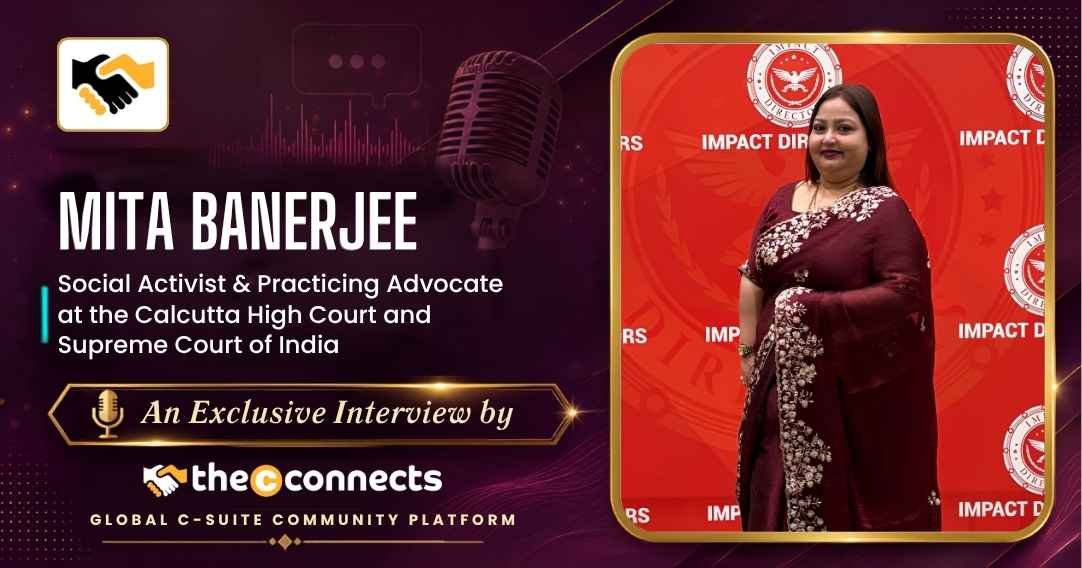

Welcome, Advocate Mita Banerjee! It is an absolute honor to have you with us today. First and foremost, congratulations on your phenomenal journey-including being nominated for the prestigious Padma Shri in both 2024 and 2027. Between representing India at the United Nations General Assembly three times, speaking at the G-20 Summit, and receiving over 45 national and international awards, your impact is undeniable. Your legal practice is incredibly vast, spanning the Supreme Court of India, the High Court at Calcutta, and all District & Session Courts across the country. Given your demanding schedule managing high-stakes litigation, complex arbitration, and grassroots activism, we truly appreciate you taking the time for this conversation. How have you been, and what has been keeping you most occupied lately?
Mita Banerjee: Thank you so much for the incredibly warm welcome! It is a profound privilege to connect with TheCconnects and your readers. I have been doing very well, though my days are always intensely packed. Lately, I have been deeply occupied with a mix of serious constitutional and criminal litigation at the High Court and Supreme Court, alongside handling high-value corporate arbitration matters. Beyond the courtroom, I am actively conducting specialized POSH and POCSO compliance training for various organizations. Of course, my grassroots activism-especially animal rescues and providing legal awareness in underprivileged sectors-continues to be a driving force in my daily life. I am thrilled to be here and share my journey with you.
TheCconnects: Your journey is a testament to what unwavering resolve can achieve. For our readers, could you take us back to the beginning? How did you transition from a young student taking an Anti-Drug Oath at Fort William to becoming a formidable presence in India’s highest courts?
Mita Banerjee: The seeds of my legal career were planted very early. I remember being an 11-year-old taking that Anti-Drug Oath at Fort William; it instilled a deep sense of civic duty in me. I always had an inherent passion for justice. During my days at Jogesh Chandra Chaudhuri College, I was actively involved in debates and extemporaneous speaking, which really helped hone my voice.
After completing my political science degree and subsequently my LLB at Utkal University, I stepped into the legal profession. My early days as a legal intern under the Late Barrister Moniruddin Ahmed laid a strong procedural foundation. However, building my independent practice wasn’t easy. I practice primarily at the High Court at Calcutta, and I am a proud member of both the prestigious Bar Library Club (Barristers’ Club Library) and the High Court Bar Association. Entering those historically male-dominated arenas meant facing significant patriarchal bias and resistance. But I refused to back down. With sheer grit, I turned those barriers into stepping stones. Over the years, I expanded my practice to the Supreme Court of India, as well as all District & Session Courts across the country. Today, handling everything from trial advocacy to complex commercial arbitration feels like a fulfillment of that childhood promise to serve society.
TheCconnects: Behind every fearless trailblazer, there is usually a strong support system. Who has influenced you the most in your life and shaped your philosophy?
Mita Banerjee: I have been blessed with an incredible lineage and support system. My late father, Ashoke Banerjee, was my ultimate guiding mentor. He held my hand through the darkest trials of my early career. I still vividly remember an incident where my father and I assisted an elderly blind woman in getting medical treatment-that singular moment deepened my conviction to fight for the underprivileged.
Equally, my husband, Barun Kumar Ray, who is also an advocate, has been my constant source of inspiration and strength. Society often says there is a woman behind every successful man, but in my case, these incredible men have been the wind beneath my wings. I also draw immense inspiration from my grandfathers-my paternal grandfather was an accomplished industrialist, and my maternal grandfather was a distinguished ‘Tamra-Patra’ recipient. That blend of entrepreneurial spirit and patriotic duty runs in my veins.
TheCconnects: You have taken on cases for transgender individuals, sex workers, and conducted legal literacy in the highly volatile Naxal-affected areas of Bastar. What are the biggest challenges you have faced in these endeavors, and how did you overcome them?
Mita Banerjee: The greatest challenge in social activism and human rights law is breaking through systemic apathy. When you step into marginalized zones-whether it is educating tribal populations in Bastar about their legal rights or fighting for the dignity of sex workers and the transgender community-you are not just fighting a legal battle; you are fighting deeply ingrained societal prejudices.
There were times when the resistance was palpable, and resources were scarce. I have personally stepped in to perform the final rites for unidentified deceased individuals because dignity in death is just as important as dignity in life. I overcame these challenges by refusing to view law merely as a profession. I integrated my legal knowledge with a Diploma in Psychotherapy to better understand the psychological dimensions of crime and societal behavior, allowing me to approach these challenges with both legal precision and profound empathy.
TheCconnects: That intersection of psychology and law is fascinating. What key lessons have you learned from this unique, multi-dimensional professional career?
Mita Banerjee: The most vital lesson is that the strength of our legal system does not lie merely in its statutes, but in their just and impartial implementation. Empathy without action is just an emotion, and law without compassion is just a rulebook. I’ve learned that true justice requires protecting the vulnerable-which is why I specialize heavily in crimes related to women, senior citizens, and children. Another key lesson is the power of visibility and discipline. Whether I am addressing the United Nations General Assembly, handling an intense arbitration proceeding, or arguing in a district court, the commitment to truth must remain absolute and unwavering.
TheCconnects: Adapting one of our standard questions to your field-what do you see as the biggest challenge for the legal protection of individuals and brands in today’s rapidly expanding digital space?
Mita Banerjee: The digital space has completely mutated the nature of crime, harassment, and corporate disputes. The biggest challenge today is cyber harassment, digital stalking, and the complexities of enforcing the POSH Act in remote or hybrid work environments. For brands and corporations, the challenge is ensuring absolute digital compliance and protecting their workforce from virtual exploitation while keeping commercial secrets safe. This is where my arbitration practice becomes critical. Brands today prefer resolving complex digital and corporate disputes through confidential arbitration rather than dragging them through prolonged, public litigation. The law is constantly racing to catch up with technology, so proactive compliance is the only viable defense.
TheCconnects: You are a highly sought-after Medico-Legal Consultant and POSH/POCSO Expert. How does your specific approach address the deep pain points of your clients in these sensitive areas?
Mita Banerjee: Victims of sexual harassment or child abuse are already traumatized; the legal process shouldn’t re-traumatize them. My clients’ biggest pain point is the fear of exposure, societal judgment, and procedural intimidation. I address this by providing an environment of absolute confidentiality, sensitivity, and psychological support. Because I have a background in psychotherapy, I don’t just treat them as “case files.” Whether it is a complex corporate POSH inquiry or a highly sensitive POCSO trial, I ensure that the victim’s dignity is protected while relentlessly pursuing accountability.
TheCconnects: With such a heavy and emotionally taxing workload, how do you decompress? What do you do in your free time?
Mita Banerjee: My activism for animal rights is very close to my heart. Fighting against animal cruelty isn’t just work for me; it is a spiritual commitment. I firmly believe animals have the same right to this planet as we do. Beyond that, I find immense joy in the simple things, like cooking for my beloved husband. I am also a voracious reader of history and Indian mythology. I believe our mythology is actually the rich, unadulterated history of Indian culture, architecture, and science, much of which was distorted by invaders. Reading brings me peace and reconnects me to our heritage.
TheCconnects: As we conclude, what advice do you have for aspiring advocates, social activists, and young women looking to make a mark in male-dominated industries?
Mita Banerjee: Never compromise your integrity for materialistic gains. The pursuit of truth must always be your ultimate goal. The legal profession demands extreme grit; there will be times when society or the system will try to push you down, simply because you are a woman or because you are fighting for an unpopular truth. Let every setback fuel your resolve. Empower yourself with knowledge-do not just read the law, understand the human condition behind the law. If you stand resolutely for justice without discrimination of caste, gender, or creed, the universe will make way for you.
TheCconnects: Those are incredibly empowering words. Thank you so much for joining us today, Advocate Mita Banerjee. It has been an absolute privilege to explore your remarkable journey, your insights into the Indian legal system, and your beautiful, compassionate approach to social justice. We wish you continued success in your noble endeavors and the very best for your 2027 Padma Shri nomination!
Mita Banerjee: Thank you very much for having me. It was a deeply fulfilling conversation, and I appreciate TheCconnects for giving me this platform to share my voice and vision with your readers.