
There is a moment that almost every tech graduate experiences within the first few weeks of their first job. It arrives quietly, not with a dramatic announcement, when they realize that the skills that got them hired are not the same skills that will make them successful.
The algorithms are familiar. The data structures are practiced. The code compiles. But suddenly the job involves explaining technical decisions to non-technical stakeholders, navigating team dynamics, understanding business objectives, managing time across competing priorities, and building professional relationships in a workplace that does not run on rubrics and due dates.
For many graduates, this gap between academic preparation and professional reality is the first real career challenge. For those who recognize it early and act deliberately, it becomes the clearest competitive advantage available.
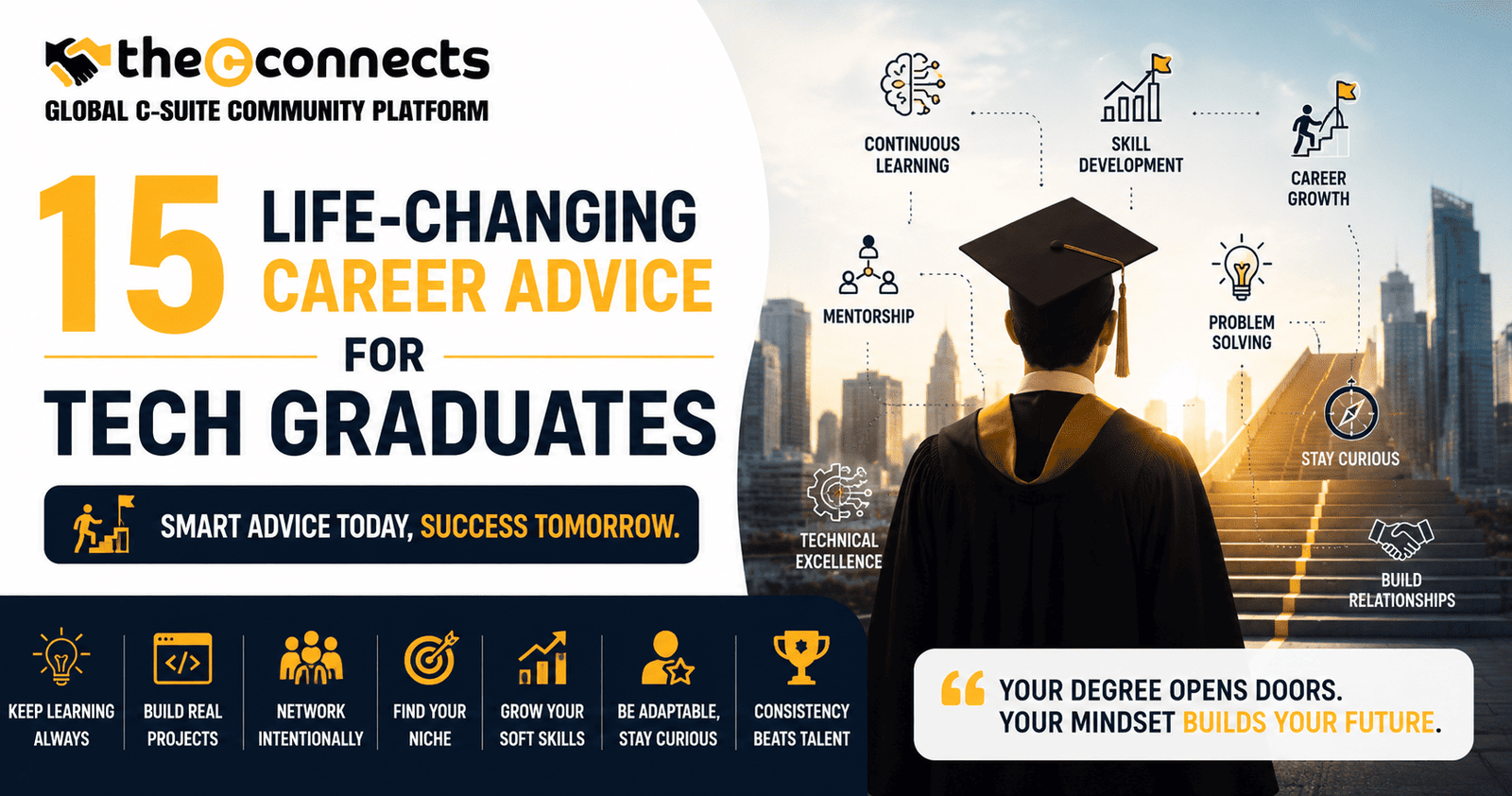
This feature presents the 15 life-changing career advice for tech graduates that the most successful early-career professionals in technology consistently credit for accelerating their growth, insights drawn from industry patterns, hiring realities, and the evolving demands of a profession being reshaped by AI, automation, and global remote work.
1. Build Communication Skills as Deliberately as Coding Skills
Technical ability without communication ability has a career ceiling. The engineers who advance to senior, staff, and principal levels, and those who eventually move into technical leadership or found companies, are consistently those who can explain complex technical decisions in language that non-technical stakeholders understand and act on.
Why it matters: Most consequential technical decisions involve non-technical decision-makers. Budgets, timelines, product direction, and team structure are all influenced by how well technical people communicate their constraints, recommendations, and concerns.
Actionable tip: Volunteer to present technical work in team meetings. Write a weekly update summarizing your work in plain language. Practice explaining your projects to a friend or family member with no technical background, the gaps in their understanding reveal the gaps in your communication.
2. Develop a Problem-Solving Mindset, Not Just a Coding Mindset
Employers hire engineers to solve problems. Code is the tool. The engineers who become indispensable are those who identify problems others have not seen, propose solutions others have not considered, and implement them in ways that are maintainable, scalable, and aligned with business constraints.
Common mistake: Graduates who focus exclusively on writing code often miss the upstream questions, is this the right problem to solve? Is this the most effective solution? Is there a simpler approach that achieves the same outcome?
Actionable tip: Before writing a single line of code, spend time clearly defining the problem. Document your understanding of the requirements, the constraints, and the expected outcome. This habit separates junior engineers from senior ones faster than any technical skill.
3. Learn AI and Automation Fundamentals, Regardless of Your Specialization
Artificial intelligence is not a specialization anymore, it is infrastructure. Regardless of whether you work in front-end development, DevOps, data engineering, or QA, understanding the fundamentals of AI tools, language models, and automation workflows is now a baseline professional literacy requirement.
Why it matters: The engineers who will be most valuable in the next five years are not those who fear AI tools but those who can use them to multiply their own output quality and speed.
Actionable tip: Spend two to three hours per week experimenting with AI developer tools. Build a small project using an LLM API. Take a foundational course in machine learning concepts even if you do not intend to become an ML engineer, context is competitiveness.
4. Create a LinkedIn Profile That Works While You Sleep
Your LinkedIn profile is your professional presence in the largest network of business and technical decision-makers in the world. A poorly maintained LinkedIn profile is not neutral, it is actively working against you by creating the impression that you are not serious about your professional development.
What to include: A professional photo, a headline that describes what you do and the value you bring (not just your job title), a summary that reads like a person rather than a resume, and specific achievements with quantified outcomes where possible.
Actionable tip: Post one professional update per week, a project insight, a technical lesson learned, a book or course recommendation. Consistent, valuable posting builds the professional visibility that generates opportunities you did not go looking for.
5. Build a Portfolio With Real Problems, Not Tutorial Projects
GitHub repositories full of To-Do app clones and tutorial follow-alongs do not demonstrate engineering capability, they demonstrate the ability to follow instructions. A portfolio of real, original projects that solve actual problems demonstrates the judgment, creativity, and technical execution that hiring managers are assessing.
Why it matters: In a competitive hiring environment, a portfolio that demonstrates genuine problem-solving separates candidates who look similar on paper.
Actionable tip: Identify a genuine problem in your daily life or community, a scheduling challenge, a data gap, an inefficiency, and build a solution. Document the problem, your approach, the technical decisions you made, and what you would do differently. That documentation is as important as the code.
6. Understand Business and Customer Needs, Not Just Technical Requirements
The most effective engineers are those who understand why a feature or system matters, who it serves, what problem it solves, and how it connects to the organization’s commercial objectives. This understanding enables better technical decisions and makes every contribution more impactful.
Actionable tip: Ask your product manager or business stakeholders about the customer need behind every feature you build. Read customer feedback. Sit in on user research sessions if the opportunity exists. Engineers who understand the customer build better products.
7. Invest in Teamwork and Collaborative Engineering Habits
Software is built in teams. Code review, pair programming, stand-up communication, and collaborative problem-solving are all team sports that require deliberate skill development. Engineers who are difficult to collaborate with, regardless of their individual technical ability, have limited career trajectories in most organizations.
Common mistake: Viewing code review feedback as criticism rather than as collaborative quality improvement. The engineers who grow fastest are those who engage genuinely with review feedback and provide thoughtful, constructive reviews in return.
8. Commit to Continuous Learning as a Professional Obligation
The half-life of specific technical skills in software engineering is shorter than in almost any other profession. Technologies that were cutting-edge five years ago are legacy today. Engineers who stop learning after their first job stop growing, and eventually find themselves on the wrong side of hiring decisions.
Actionable tip: Allocate a minimum of five hours per week to deliberate learning, not passive consumption, but active study, practice, and application. Build something with what you learn. Teaching others what you have learned accelerates your own retention and builds your professional reputation simultaneously.
9. Build Networking Habits Before You Need Them
Professional networks are most useful when you are not actively job-searching, because they generate opportunities before you need them. Engineers who build relationships with peers, senior engineers, and industry professionals throughout their careers consistently access opportunities that those without networks simply never hear about.
Actionable tip: Attend local and virtual tech meetups, contribute to open-source projects, engage genuinely on LinkedIn and Twitter/X, and reach out to people whose work you find interesting with specific, thoughtful messages. Ask for conversations, not favors.
10. Develop Foundational Knowledge in Cloud and Cybersecurity
Cloud computing and cybersecurity are not specializations reserved for specialists; they are dimensions of professional engineering literacy that affect every technical decision made in modern software development. Understanding how cloud infrastructure works, how to build for security, and how to implement basic security practices is now a baseline expectation.
Actionable tip: Pursue a foundational cloud certification, AWS Cloud Practitioner, Google Cloud Associate, or Azure Fundamentals, and a basic security literacy course within your first two years. These credentials signal professional seriousness and provide genuinely useful knowledge.
11. Practice Interview Communication as a Separate Skill
Technical interviews assess both technical knowledge and the ability to communicate technical thinking under pressure. Many capable engineers interview poorly because they have not practiced the specific skill of articulating their problem-solving process out loud in real time.
Actionable tip: Practice coding challenges on a whiteboard or shared document while explaining your thinking verbally. Pair with peers for mock interviews. The goal is to make articulation feel natural, not effortful, when the stakes are high.
12. Build Personal Branding Through Consistent Online Contribution
Your personal brand is the impression that exists in the minds of people who know your name but have not worked directly with you. For tech professionals, this impression is shaped by your GitHub contributions, LinkedIn activity, blog posts, conference talks, and the quality of your engagement in professional communities.
Why it matters: Hiring managers, venture investors, and potential collaborators regularly discover professionals through their online presence before any formal introduction occurs.
Actionable tip: Write about what you are learning. Share what you have built. Contribute to technical discussions in communities you respect. Consistency over months and years builds the kind of professional reputation that no resume alone achieves.
13. Stay Adaptable, Technology Shifts Are Career Opportunities, Not Threats
Every major technology shift, mobile computing, cloud infrastructure, big data, AI , has created more career opportunities than it has eliminated. Engineers who resist change are threatened by it. Those who lean into it are positioned to be among the early movers in the next wave of opportunity.
Actionable tip: When a major technology shift occurs in your domain, spend time understanding it fundamentally, not just its surface features, but its underlying mechanics and the problems it solves. Early depth in an emerging technology is a significant competitive advantage.
14. Manage Your Energy and Protect Against Burnout
Burnout in the technology industry is both common and frequently underestimated. The culture of always-on availability, the psychological intensity of demanding technical problem-solving, and the ambition that drives most talented engineers create conditions where burnout is a genuine career risk, not a personal weakness.
Actionable tip: Define boundaries between work time and personal time. Protect time for non-screen activities. Build recovery into your weekly schedule the same way you build learning time. The engineers who sustain high performance over decades are those who manage their energy, not just their time.
15. Find Mentors and Build Relationships With Senior Engineers
Mentorship compresses career development timelines. A mentor who has navigated the challenges you are currently facing can provide context, frameworks, and perspective that would otherwise take years to develop through trial and error alone.
How to find mentors: You do not need a formal mentorship program. Genuine relationships with senior engineers develop through authentic engagement, asking thoughtful questions, sharing your work, showing genuine curiosity about their experience. Most senior engineers are happy to invest time in people who demonstrate genuine commitment to growth.
Conclusion:
The 15 life-changing career advice for tech graduates covered in this guide collectively represent the difference between a career that develops by accident and one that develops by design. None of the advice here is passive, all of it requires deliberate action, consistent practice, and the kind of professional self-awareness that distinguishes long-term contributors from those who plateau early.
Start with the advice most relevant to your current situation. Build the habits that compound over years. Seek the mentors who can accelerate your trajectory. And treat your career as the most important product you will ever build, deserving the same thoughtful architecture, continuous iteration, and long-term commitment that the best software receives.
The technology industry rewards those who stay curious, stay adaptable, and stay genuinely committed to solving problems that matter.
Contact TheCconnects
If you are a software engineer, tech leader, recruiter, startup founder, career coach, AI professional, or industry expert with insights on career growth, professional development, emerging technologies, or workplace success in the tech industry, TheCconnects welcomes your expertise and perspective.
And if you would like to publish your article, career advice, technology insights, industry experience, or thought leadership content on this platform or any other leading media platform, please feel free to reach out to us.
📧 Email: contact@thecconnects.com
📞 Call: +91 91331 10730
💬 WhatsApp: https://wa.me/919133110730