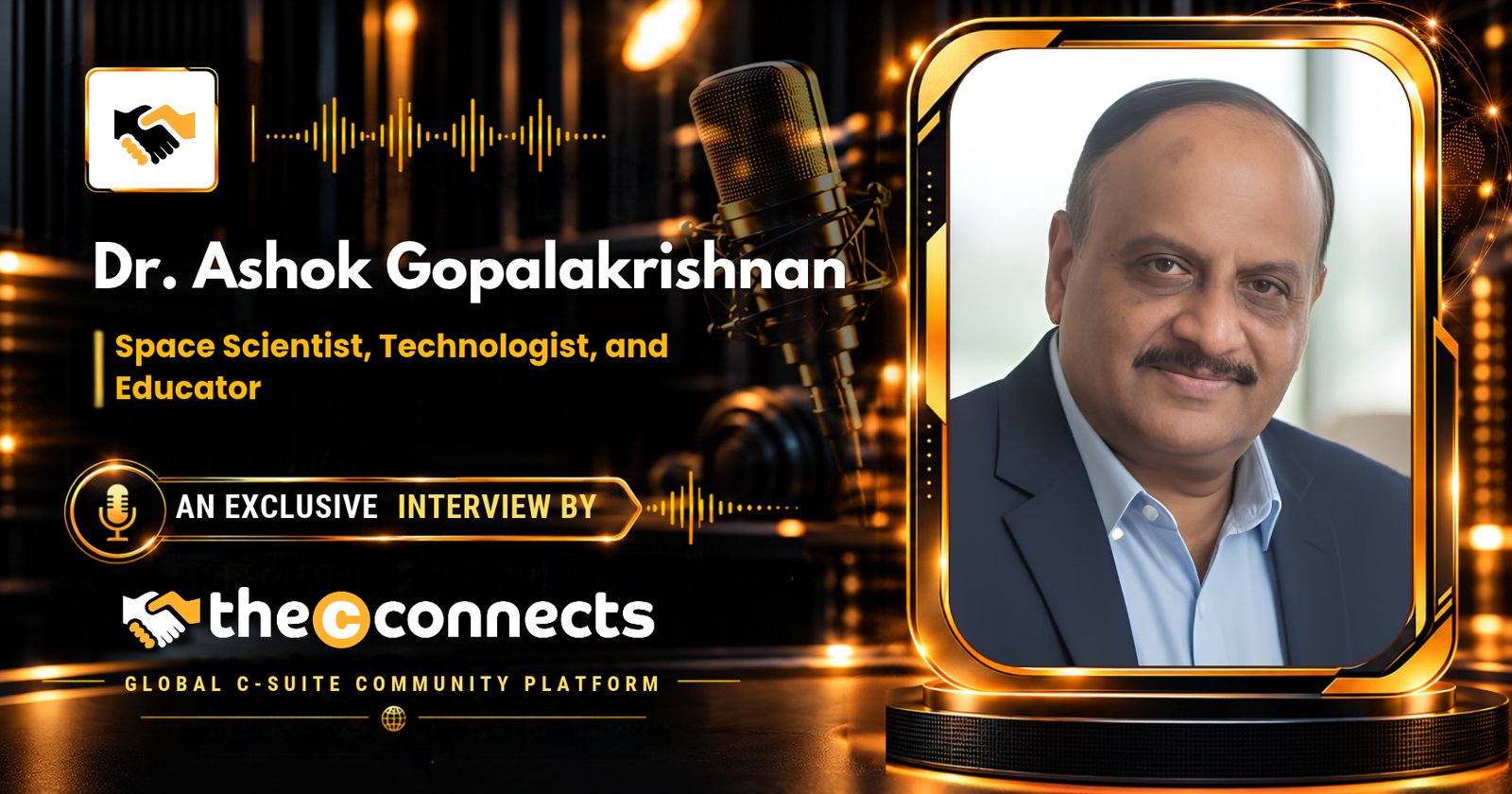

Welcome, Dr. Ashok Gopalakrishnan! It is a distinct honor to host a scientist and educator of your magnitude today. Your career is a staggering convergence of disciplines-holding dual doctorates in Computer Science and Space Physics/Astrophysics from Georgia Tech, alongside deep expertise from IIT-Bombay and Oxford. From working on the reentry trajectory of the Columbia Space Shuttle at NASA and managing massive Y2K projects at IBM, to mentoring over a thousand IIT aspirants and corporate executives in India, your trajectory is truly unparalleled. You’ve been named a Top 100 Leader in Education globally and serve as a STEM Educator and Ambassador for NASA. Given your lifelong dedication to expanding human knowledge, we are thrilled to dive into your journey. How are you doing, and what is keeping you most energized in your current role?
Dr. Ashok Gopalakrishnan: Thank you for the incredibly warm welcome! It is a pleasure to connect with TheCconnects and your readers. I am doing very well. What keeps me most energized right now is the massive intersection of Artificial Intelligence, Space Science, and the next generation of students. Operating as the CEO of Dr. Ashok’s Academy for Excellence in Education, and simultaneously engaging with initiatives like India Space Week as a Scientist Emeritus, allows me to bridge advanced research with grassroots STEM education. Seeing young minds light up when they realize that the algorithms they learn in a Python class are the exact same mathematical principles we use for planetary exploration-that is what keeps me highly motivated every single day.
TheCconnects: Your professional journey spans foundational scientific research at NASA, enterprise technology at IBM, and academic leadership across the US and India. Can you walk our readers through this extraordinary evolution?
Dr. Ashok Gopalakrishnan: My journey has been driven by a relentless curiosity about how systems-both cosmic and computational-function. It started with a very strong mathematical foundation in India, earning my M.Sc. in Applied Mathematics and later an M.Tech in Environmental Engineering from IIT-Bombay. However, my passion was always the cosmos.
I went to the United States to pursue my Ph.D. at Georgia Tech in Space Physics, Astronomy, and Computer Science. That interdisciplinary background was incredibly rare at the time and opened the door for me at NASA in 1985. I spent seven years there as a Project Scientist, working on complex aerospace problems like the Columbia Space Shuttle reentry and the early stages of the Mars project.
Eventually, I wanted to understand the commercial and enterprise applications of massive computational power, which led me to IBM. I spent eight years there managing WebSphere technology and navigating the Y2K transition for the banking sector. After decades in the US, I returned to India. I wanted to give back. I transitioned entirely into academia and education leadership-serving as a Professor, Principal, and ultimately founding my own academy to mentor the next generation of engineers, scientists, and IT professionals.
TheCconnects: With such a multifaceted career bridging the deepest mysteries of space and the rigid logic of computer science, who or what has influenced you the most in your life?
Dr. Ashok Gopalakrishnan: My greatest influence has been the absolute precision and mathematical beauty of the universe itself. When you study astrophysics, you realize that the cosmos is not chaotic; it is governed by deeply elegant algorithms. That realization profoundly shaped my approach to everything, from writing a C++ program to teaching a high school student physics.
On a human level, my professors at IIT-Bombay and Georgia Tech were monumental influences. They taught me that true brilliance does not lie in hoarding knowledge, but in simplifying the complex so others can build upon it. That is why I transitioned from purely being a scientist to becoming an educator. My mentors instilled in me the belief that the highest calling of a researcher is to create more researchers.
TheCconnects: Working on projects like the Columbia Space Shuttle at NASA and managing global financial systems at IBM must have come with immense pressure. What are the biggest challenges you have faced in your career, and how did you overcome them?
Dr. Ashok Gopalakrishnan: The biggest challenge in both space exploration and enterprise IT is the absolute zero margin for error. When I was working on the reentry problem for the space shuttle, a miscalculation in the atmospheric drag models didn’t mean a program crashed; it meant lives were at stake. Similarly, at IBM during the Y2K transition, a failure in the banking systems meant global financial paralysis.
I overcame these high-pressure challenges by relying on radical, interdisciplinary collaboration. You cannot solve a space reentry problem with astrophysics alone; you need applied mathematics, fluid dynamics, and computer science. I learned to break down massive, terrifying problems into smaller, manageable computational models, and I learned to trust the collective intelligence of my teams.
TheCconnects: After decades traversing NASA, Fortune 500 boardrooms, and academic institutions, what key lessons have you learned from your professional career?
Dr. Ashok Gopalakrishnan: The most vital lesson is that technology is merely a tool; the core driver of progress is human curiosity. Whether it is an AI algorithm or a rocket propulsion system, if the human operating it lacks fundamental curiosity and ethical grounding, the tool is useless.
Secondly, I learned that silos are the enemy of innovation. The greatest breakthroughs happen at the intersection of disciplines. If you are a computer scientist, learn biology. If you are a physicist, learn economics. The future belongs to those who can connect the dots across different fields of human knowledge.
TheCconnects: Looking at the modern landscape, what do you see as the biggest challenge for educational brands and institutions in the digital space today?
Dr. Ashok Gopalakrishnan: The biggest challenge in the digital education space is the illusion of learning. The internet has democratized access to information, but it has not democratized comprehension. We have platforms offering thousands of courses on Python, AI, and Robotics, but many students are merely memorizing syntax rather than developing computational thinking.
The challenge for educational institutions is maintaining deep, rigorous mentorship in a world addicted to instant, superficial answers. Brands in the EdTech space must transition from simply delivering content to actually fostering scientific curiosity, research aptitude, and complex problem-solving skills.
TheCconnects: How does Dr. Ashok’s Academy address these exact pain points for students and corporate executives?
Dr. Ashok Gopalakrishnan: At the academy, we fundamentally reject rote learning. When I mentor an IIT aspirant or a corporate executive from Infosys or Oracle, I don’t just teach them Java or Physics; I teach them how to model real-world problems.
We address the pain point of superficial learning by integrating advanced concepts-like Artificial Intelligence, Robotics, and Space Science-into our foundational coaching. If I am teaching a student calculus, I will show them how that exact calculus determines a satellite’s orbital trajectory. By connecting theoretical concepts to awe-inspiring real-world applications, we ignite a genuine passion for STEM that goes far beyond passing an entrance exam.
TheCconnects: With such heavy involvement in STEM outreach, academic mentoring, and scientific consulting, what does Dr. Ashok Gopalakrishnan do in his free time to recharge?
Dr. Ashok Gopalakrishnan: Given my background, my free time is still quite closely tied to science! I am an avid reader of scientific literature, particularly regarding the latest developments in quantum computing and deep space exploration. I also dedicate time to my work on Green Hydrogen-a project for which I recently received a recognition certificate from the Tamil Nadu Government. Beyond the sciences, I enjoy classical music and spending quiet time reflecting on the philosophical implications of our expanding technological capabilities.
TheCconnects: To conclude this highly inspiring conversation, what is your ultimate advice for aspiring scientists, tech entrepreneurs, and educators in India today?
Dr. Ashok Gopalakrishnan: My advice is to stop chasing trends and start solving fundamental problems. The world does not need another generic app; it needs sustainable energy solutions, robust space infrastructure, and ethical AI systems.
For aspiring students and entrepreneurs: master your foundational sciences-physics, mathematics, and computational logic. Do not be afraid to study across disciplines. For educators: remember that your job is not to fill a bucket with facts, but to light a fire of curiosity. Cultivate an environment where failure is seen as a data point for learning, not a reason to quit. The universe is incredibly vast, and human potential is equally limitless if we dare to explore it.
TheCconnects: That is exceptionally profound and actionable advice, Dr. Ashok Gopalakrishnan. Your ability to seamlessly integrate the rigors of astrophysics with the empathy required for effective education is truly visionary. Thank you so much for sharing your journey and wisdom with us today. We wish you continued success in all your endeavors!
Dr. Ashok Gopalakrishnan: The pleasure was entirely mine. Thank you to TheCconnects for this wonderful platform and for highlighting the critical importance of interdisciplinary STEM education.